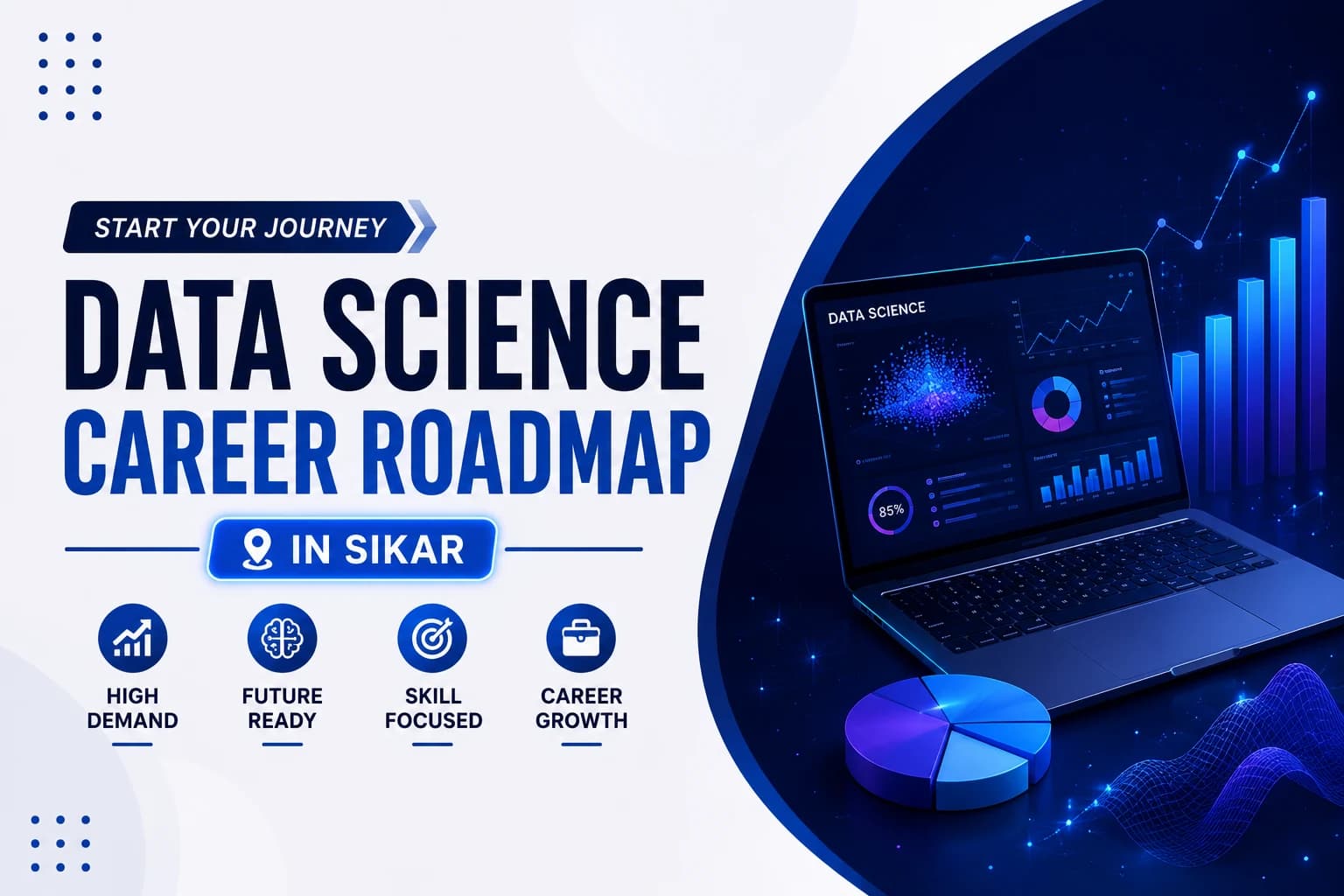
What is Data Science?
Data Science is a technology-driven field that combines statistics, mathematics, programming, machine learning, artificial intelligence, and domain knowledge to extract useful insights and build data-driven solutions.
A Data Scientist works with structured and unstructured data to understand patterns, make predictions, solve business problems, and develop intelligent systems.
Modern Data Science is no longer limited to traditional statistical analysis. AI, machine learning, deep learning, automation, Generative AI, and large language models are becoming important parts of modern data-driven workflows.
A professional Data Science course in Sikar can help students build practical skills in Python, SQL, statistics, data analysis, machine learning, data visualisation, AI, and real-world project development.
The main objective of Data Science is not simply to learn programming or mathematics. The goal is to use data and technology to solve meaningful real-world problems.
Data Science vs Data Analytics
Data Analytics mainly focuses on understanding existing data, identifying trends, creating reports, building dashboards, and helping organisations make better decisions.
Data Science covers a broader range of activities including data analysis, statistical modelling, machine learning, predictive modelling, artificial intelligence, automation, and advanced data-driven solutions.
Data Analysts commonly work with tools such as Excel, SQL, Python, and Power BI, while Data Scientists generally work with Python, SQL, statistics, machine learning frameworks, data visualisation tools, and AI technologies.
Both fields overlap, and learning Data Analytics fundamentals can provide a strong foundation for students who later want to move into Data Science and Machine Learning.
Students in Sikar can choose their learning path based on their career goal. Those interested in reporting and business insights may start with Data Analytics, while learners interested in prediction, machine learning, AI, and advanced modelling can move toward Data Science.
What does a Data Scientist do?
A Data Scientist uses data, statistics, programming, and machine learning to solve business and technical problems.
Typical responsibilities can include collecting data, cleaning datasets, exploring patterns, selecting useful features, building machine learning models, evaluating model performance, visualising results, and communicating findings.
Depending on the organisation, Data Scientists may work on customer prediction, sales forecasting, recommendation systems, fraud detection, marketing optimisation, risk analysis, demand forecasting, natural language processing, computer vision, and AI applications.
A Data Scientist may also work with data pipelines, APIs, cloud platforms, model deployment, automation, and Generative AI systems.
The role requires both technical and problem-solving skills. Understanding the business problem is often as important as building the model.
Why should you learn Data Science?
Data is being generated by businesses, websites, mobile applications, financial systems, e-commerce platforms, social media, IoT devices, and digital services. Organisations need professionals who can convert this data into useful insights and intelligent solutions.
Data Science can provide a strong technology career path for students and graduates interested in Python, mathematics, statistics, machine learning, AI, and problem-solving.
The growth of Artificial Intelligence and Generative AI is also increasing the importance of data-related skills. Understanding data, models, evaluation, and machine learning fundamentals can help learners work effectively with modern AI technologies.
Students from Sikar can build these skills locally through structured learning, practical projects, self-practice, internships, and portfolio development.
Instead of focusing only on certificates, learners should focus on building practical skills and demonstrating their ability through projects.
What do you learn in a Data Science course?
A complete Data Science course should gradually move from programming and data fundamentals to statistics, machine learning, AI, advanced projects, and deployment concepts.
Students can begin with Python programming, including variables, data types, conditions, loops, functions, object-oriented programming, modules, file handling, error handling, and practical coding.
Data handling can include NumPy, Pandas, data cleaning, missing-value treatment, duplicate removal, data transformation, feature preparation, and exploratory data analysis.
SQL is important for working with structured data stored in relational databases. Students can learn queries, joins, subqueries, aggregations, window functions, database concepts, and analytical SQL.
Statistics can include descriptive statistics, probability, distributions, correlation, hypothesis testing, confidence intervals, sampling, regression concepts, and statistical interpretation.
Machine Learning can cover supervised learning, unsupervised learning, regression, classification, clustering, feature engineering, model evaluation, cross-validation, hyperparameter tuning, and model selection.
Students can also learn data visualisation using Matplotlib, Seaborn, Plotly, Power BI, or other relevant tools depending on the course structure.
Advanced Data Science learning can include Natural Language Processing, recommendation systems, time-series forecasting, computer vision, deep learning, and AI applications.
A modern course should also introduce Generative AI concepts, LLM fundamentals, embeddings, prompt engineering, RAG concepts, AI APIs, and practical AI application development where appropriate.
The most important part of learning Data Science is practical implementation. Students should work with real-world datasets and solve complete problems instead of learning concepts only from theory.
Role of AI and Generative AI in Data Science
Artificial Intelligence has become an important part of modern Data Science. Machine learning models can identify patterns in data and make predictions, while newer Generative AI systems can work with text, images, code, documents, and other types of information.
A modern Data Science learner should understand how AI fits into the complete data workflow rather than treating AI as a separate technology.
Generative AI can support tasks such as data exploration, code assistance, documentation, natural language interfaces, report generation, text classification, summarisation, information extraction, and AI-powered applications.
Students can learn the fundamentals of Large Language Models, prompts, tokens, embeddings, vector databases, Retrieval-Augmented Generation, AI APIs, and responsible AI usage.
AI tools should be used to improve productivity, but students should still understand Python, statistics, SQL, machine learning, data structures, model evaluation, and data quality because AI-generated output can contain errors.
A strong Data Science course in Sikar should therefore combine traditional Data Science fundamentals with practical AI and Generative AI skills.
Data Science Career Roadmap
Becoming a Data Scientist is a step-by-step process. Students should not try to learn every technology at the same time. Strong fundamentals make advanced machine learning and AI concepts easier to understand.
A practical Data Science roadmap can start with Python programming, followed by SQL, statistics, data analysis, data visualisation, machine learning, advanced machine learning, AI, deep learning, Generative AI, real-world projects, portfolio development, and interview preparation.
A complete roadmap can be understood as:
Python → NumPy & Pandas → SQL → Statistics & Probability → Data Cleaning → Exploratory Data Analysis → Data Visualisation → Machine Learning → Feature Engineering → Model Evaluation → Advanced Machine Learning → Deep Learning → NLP → Computer Vision → Generative AI → LLMs & RAG → Real-World Projects → Deployment Basics → Portfolio → Interview Preparation → Internship or Job.
Learners should continuously practise coding, solve datasets, read documentation, build projects, analyse mistakes, and understand why a particular algorithm or technique is suitable for a problem.
The goal should be to become a problem solver who can use data, programming, statistics, machine learning, and AI together.
Tools and Technologies used in Data Science
Data Scientists use different tools depending on their organisation, project, industry, and responsibilities.
Python is one of the most important programming languages for Data Science and is commonly used for data cleaning, analysis, machine learning, automation, and AI development.
NumPy and Pandas are useful for numerical computing, data manipulation, data cleaning, transformation, and exploratory analysis.
SQL is important for accessing and analysing structured data stored in relational databases.
Matplotlib, Seaborn, and Plotly can be used for data visualisation and exploratory analysis.
Scikit-learn provides practical tools for many traditional machine learning tasks such as classification, regression, clustering, preprocessing, and model evaluation.
TensorFlow and PyTorch can be used for deep learning and neural network development.
Jupyter Notebook and Google Colab can be useful environments for experimentation, data analysis, and machine learning practice.
Power BI can complement Data Science skills by helping communicate analytical results through dashboards and business reports.
Modern AI workflows can also involve AI APIs, embedding models, vector databases, Git, GitHub, Docker, cloud platforms, and model deployment tools.
Students should learn tools based on practical use cases instead of simply collecting the names of technologies.
Real-World Data Science Projects
Project work is one of the most important parts of becoming job-ready in Data Science. Projects allow students to apply programming, statistics, data analysis, machine learning, and problem-solving skills.
A beginner project can involve exploratory analysis of a sales, customer, retail, education, or marketing dataset.
Intermediate projects can include customer churn prediction, house price prediction, sales forecasting, customer segmentation, loan risk analysis, fraud detection, employee attrition prediction, and recommendation systems.
Advanced projects can combine machine learning, APIs, dashboards, deployment, automation, and AI components.
Every major project should ideally include problem definition, data collection, data cleaning, exploratory analysis, feature engineering, model development, evaluation, visualisation, conclusions, and business recommendations.
Students should document their projects properly and publish suitable work on GitHub or a portfolio website so that recruiters can understand their practical abilities.
AI and Machine Learning Projects
Modern Data Science students should build projects that demonstrate both traditional machine learning and practical AI skills.
Machine Learning projects can include customer churn prediction, house price prediction, credit risk prediction, sales forecasting, recommendation systems, customer segmentation, sentiment analysis, fraud detection, and demand prediction.
Natural Language Processing projects can include sentiment analysis, text classification, document classification, spam detection, resume analysis, and customer feedback analysis.
Generative AI projects can include an AI document assistant, knowledge-base chatbot, PDF question-answering system, RAG-based education assistant, AI report generator, AI-powered data assistant, or natural-language data query system.
Students can also build an AI-powered analytics assistant that allows users to ask questions about business data using natural language and receive data-driven responses.
The objective should be to build projects that demonstrate real problem-solving rather than projects that only display a trained model.
Career Opportunities after Data Science
After developing strong technical and practical skills, learners can explore different entry-level and junior technology roles.
Possible career paths include Junior Data Scientist, Data Scientist, Machine Learning Engineer, Data Analyst, Business Analyst, AI Engineer, ML Engineer, Data Science Intern, Research Assistant, and Business Intelligence roles depending on skills and experience.
Learners with strong Python and machine learning skills can focus on predictive modelling and ML-related roles.
Learners interested in AI can develop additional skills in deep learning, NLP, computer vision, Generative AI, LLMs, RAG, APIs, and deployment.
Data Science skills can also support freelance analytics, dashboard projects, automation solutions, AI prototypes, data consulting, and startup projects.
Career growth depends on practical skills, problem-solving ability, project experience, communication, business understanding, continuous learning, and the ability to work with modern tools.
Skills required to become a Data Scientist
A Data Scientist needs a combination of technical, analytical, business, and communication skills.
Important technical skills include Python, SQL, statistics, probability, data structures, Pandas, NumPy, data visualisation, machine learning, and model evaluation.
Advanced skills may include deep learning, NLP, computer vision, time-series forecasting, recommendation systems, Generative AI, LLMs, RAG, APIs, cloud platforms, and model deployment.
Analytical thinking is important because Data Science involves converting unclear business problems into measurable data problems.
Communication skills are also important because Data Scientists need to explain findings, assumptions, limitations, model results, and recommendations to technical and non-technical stakeholders.
Students should also develop Git and GitHub skills, documentation habits, presentation skills, portfolio development, and interview problem-solving skills.
Learning Data Science in Sikar
Students in Sikar who want to build a career in Data Science can start by developing strong programming, mathematics, statistics, and analytical fundamentals.
Sikar has a large student population preparing for higher education and professional careers. Students from different academic backgrounds can explore Data Science based on their interests and learning goals.
Students do not necessarily need to move to a major metro city to start learning the fundamentals of Data Science. With structured classroom training, practical labs, online documentation, projects, internships, and consistent self-practice, learners can build their skills from Sikar.
A Data Science course in Sikar should ideally provide practical exposure to Python, SQL, statistics, machine learning, AI, data visualisation, projects, Git/GitHub, and career preparation.
Students should also focus on building a portfolio that demonstrates what they can actually build rather than relying only on a course certificate.
How to choose a Data Science course in Sikar
When comparing Data Science courses in Sikar, students should not choose a course only because of its name, duration, certificate, or promotional claims.
Check whether the curriculum covers Python, NumPy, Pandas, SQL, statistics, probability, data visualisation, machine learning, model evaluation, advanced machine learning, AI, and practical projects.
For a modern 2026-focused curriculum, students should also check whether the course introduces Generative AI, LLM fundamentals, embeddings, RAG, AI APIs, and practical AI applications.
Students should check whether classes include hands-on coding, datasets, assignments, debugging, case studies, and project development.
Before joining a Data Science institute in Sikar, students should also evaluate trainer experience, lab facilities, batch size, project quality, GitHub/portfolio guidance, internship support, interview preparation, and career guidance.
The best course is not necessarily the one with the largest syllabus. A good course should provide a balanced combination of fundamentals, practical work, modern AI skills, projects, and career preparation.
Who can learn Data Science?
Data Science can be learned by college students, graduates, beginners, working professionals, and learners who want to move into data-driven technology careers.
Students from BCA, MCA, BSc Computer Science, BSc Mathematics, BSc Statistics, BTech, BE, BBA, BCom, and other backgrounds can explore Data Science based on their interests and learning goals.
Students with mathematics or statistics backgrounds may find statistical concepts easier, while programming students may find Python and software development concepts more familiar.
Students from non-technical backgrounds can also begin learning Data Science, but they may need additional time to build programming, mathematics, and statistics fundamentals.
Beginners should select a learning path that starts from fundamentals instead of directly jumping into advanced AI or deep learning.
Do you need a specific degree for Data Science?
There is no single academic background that automatically makes someone a Data Scientist. Different organisations may have different educational requirements.
A background in computer science, mathematics, statistics, engineering, economics, or another quantitative field can provide useful foundations.
However, practical skills are extremely important. Learners should develop programming, statistics, machine learning, problem-solving, and project-building abilities.
Students should check the educational requirements of the specific jobs they want to apply for because some organisations may prefer or require particular degrees or qualifications.
For beginners, the most important starting point is to build strong fundamentals and gradually progress toward real-world Data Science projects.
How to build a Data Science portfolio
A strong Data Science portfolio can help students demonstrate their practical skills to recruiters and potential employers.
A portfolio should include multiple projects covering different types of problems instead of several projects that all use the same dataset.
A good portfolio can include an exploratory data analysis project, machine learning prediction project, classification project, time-series project, NLP project, and at least one modern AI or Generative AI project.
Each project should explain the problem, dataset, approach, data cleaning, feature engineering, model selection, evaluation metrics, results, and business impact.
Students should use GitHub to maintain clean repositories with useful README files, code organisation, screenshots, requirements, and project explanations.
A personal portfolio website can further showcase projects, technical skills, certifications, achievements, resume, and contact information.
Data Science Interview Preparation
Data Science interview preparation should cover both technical fundamentals and practical problem-solving.
Students should prepare Python programming, SQL queries, statistics, probability, Pandas, NumPy, machine learning algorithms, feature engineering, model evaluation, and data visualisation.
Machine Learning interviews may include questions about regression, classification, decision trees, random forests, boosting, clustering, overfitting, underfitting, cross-validation, precision, recall, F1-score, ROC-AUC, and model selection.
Modern AI interviews may also include questions about embeddings, vector databases, LLMs, RAG, prompt engineering, AI APIs, hallucinations, evaluation, and responsible AI practices depending on the role.
Students should also practise explaining their projects clearly. Interviewers may ask why a particular dataset, feature, algorithm, metric, or architecture was selected.
Mock interviews, coding practice, SQL practice, project discussions, and case-study questions can help students become more confident.
Next Steps to Start a Data Science Career
If you are searching for a Data Science course in Sikar, compare the curriculum, practical training, AI coverage, projects, trainers, lab environment, portfolio support, internship opportunities, and career guidance before choosing a course.
Start with Python and data fundamentals rather than directly jumping into advanced AI. Build a strong understanding of SQL, statistics, Pandas, NumPy, and data visualisation.
After building the foundation, move into machine learning, model evaluation, advanced machine learning, deep learning, NLP, and modern Generative AI concepts.
Build real-world projects throughout the learning process. Do not wait until the end of the course to start projects.
Create a GitHub portfolio, prepare a professional resume, practise technical interviews, apply for internships, and continuously improve your skills based on real-world requirements.
The goal should not simply be to complete a Data Science course. The goal should be to become capable of using data, programming, machine learning, and AI to solve real-world problems.
Success Point Team
Published By Success Point Team, Sikar.
Frequently asked questions
What is Data Science?
Data Science is a field that combines programming, statistics, mathematics, data analysis, machine learning, and artificial intelligence to extract insights from data and build data-driven solutions.
What is a Data Science course?
A Data Science course teaches skills such as Python, SQL, statistics, data analysis, Pandas, NumPy, data visualisation, machine learning, AI, and practical project development.
What is the Data Science career roadmap?
A practical roadmap can include Python, NumPy, Pandas, SQL, statistics, data visualisation, machine learning, feature engineering, model evaluation, deep learning, NLP, Generative AI, real-world projects, portfolio development, and interview preparation.
Is Data Science a good career option?
Data Science can be a strong career option for learners interested in programming, statistics, machine learning, artificial intelligence, data analysis, and problem-solving. Career outcomes depend on practical skills, projects, experience, and the requirements of individual employers.
Can beginners learn Data Science?
Yes. Beginners can learn Data Science by starting with Python, basic mathematics, statistics, SQL, data handling, and gradually progressing to machine learning and AI.
Can BCA students become Data Scientists?
Yes. BCA students can learn Data Science by building additional skills in Python, statistics, SQL, machine learning, data analysis, AI, and real-world project development.
Can BCom or BBA students learn Data Science?
Yes. Students from commerce and management backgrounds can learn Data Science, although they may need additional practice in programming, mathematics, and statistics.
Do I need Python for Data Science?
Python is one of the most important programming languages for Data Science and is widely used for data cleaning, analysis, machine learning, automation, and AI applications.
Is SQL important for Data Science?
Yes. SQL is an important skill for accessing, filtering, joining, aggregating, and analysing data stored in relational databases.
Is Mathematics required for Data Science?
Basic mathematics, statistics, and probability are important for understanding Data Science and machine learning concepts. The depth required depends on the role and career path.
Is Machine Learning part of Data Science?
Yes. Machine Learning is an important part of modern Data Science and is used for prediction, classification, clustering, recommendation, forecasting, and other data-driven applications.
Is AI important for Data Science in 2026?
AI is an increasingly important part of modern Data Science. Learners can benefit from understanding machine learning, deep learning, Generative AI, LLMs, embeddings, RAG, and AI application development along with traditional Data Science fundamentals.
What is Generative AI in Data Science?
Generative AI refers to AI systems that can generate or transform content such as text, code, images, or other information. In Data Science, it can be used for data assistance, document analysis, natural-language interfaces, automation, and AI-powered applications.
What projects should I build for Data Science?
Useful projects can include customer churn prediction, sales forecasting, customer segmentation, recommendation systems, fraud detection, sentiment analysis, NLP applications, and Generative AI projects such as RAG-based assistants.
What tools are used in Data Science?
Common tools include Python, SQL, NumPy, Pandas, Matplotlib, Seaborn, Plotly, Scikit-learn, TensorFlow, PyTorch, Jupyter, Git, GitHub, Power BI, and various AI APIs and cloud technologies.
How do I choose a Data Science institute in Sikar?
Compare the curriculum, Python and SQL training, statistics, machine learning, AI and Generative AI coverage, practical projects, trainer experience, lab facilities, batch size, GitHub and portfolio support, internship opportunities, and career guidance.
Is there a Data Science course in Sikar for beginners?
Yes. Beginners can look for courses that start with Python, basic mathematics, statistics, SQL, data analysis, and gradually progress toward machine learning, AI, and real-world projects.
Can I learn AI and Data Science together?
Yes. Modern Data Science learning can combine Python, statistics, data analysis, machine learning, deep learning, Generative AI, LLMs, and practical AI applications.
Can I get an internship after learning Data Science?
Students with practical skills and a strong project portfolio can apply for Data Science, Data Analytics, Machine Learning, and AI internships. Internship availability depends on individual organisations and their hiring requirements.
Do I need a degree to become a Data Scientist?
Educational requirements vary by employer. A specific degree is not the only factor; practical skills, programming, statistics, machine learning knowledge, projects, problem-solving, and relevant experience are also important.
How long does it take to learn Data Science?
Learning time depends on your academic background, programming experience, practice time, course structure, and project work. Becoming job-ready requires consistent practice and practical project experience.
What is the difference between Data Analyst and Data Scientist?
Data Analysts mainly focus on analysing existing data, reporting, dashboards, and business insights, while Data Scientists generally work on advanced analysis, predictive modelling, machine learning, AI, and data-driven systems.
Can I become a Data Scientist after graduation?
Yes. Graduates from different backgrounds can learn Data Science by building programming, statistics, SQL, machine learning, AI, and practical project skills.
Can I learn Data Science after BCA?
Yes. BCA provides a useful programming and computer science foundation. Students can add statistics, data analysis, machine learning, AI, and advanced Data Science skills.
What should I learn first: AI or Data Science?
For most beginners, it is better to build Data Science fundamentals first, including Python, SQL, statistics, data analysis, and machine learning, before moving deeply into advanced AI concepts.
Is a Data Science certificate enough to get a job?
A certificate alone does not guarantee a job. Practical skills, projects, problem-solving ability, technical knowledge, communication, interview preparation, and relevant experience are important.
How can I build a Data Science portfolio?
Build multiple practical projects, document them properly, maintain clean GitHub repositories, explain your methodology and results, and create a portfolio website showcasing your strongest work.
What should a Data Science course in Sikar include?
A comprehensive course can include Python, NumPy, Pandas, SQL, statistics, data visualisation, machine learning, advanced ML, deep learning, NLP, Generative AI, LLM concepts, RAG, real-world projects, Git/GitHub, portfolio development, and interview preparation.
Can Data Science skills help with AI careers?
Yes. Data Science provides foundations in Python, data handling, statistics, machine learning, and model evaluation that can be useful when moving into advanced AI and machine learning roles.
What are the career options after Data Science?
Possible career paths include Data Scientist, Junior Data Scientist, Machine Learning Engineer, AI Engineer, Data Analyst, Business Analyst, ML Engineer, Data Science Intern, and other data and AI-related roles depending on skills and employer requirements.
Courses mentioned in this article
 Graduation Courses
BCA (Bachelor of Computer Applications)
A 3‑year honours‑track degree built around real software development — the best BCA in Sikar.
 Post Graduation Courses
MCA (Master of Computer Applications)
A 2‑year postgraduate program for graduates aiming at senior software roles — top MCA in Sikar.
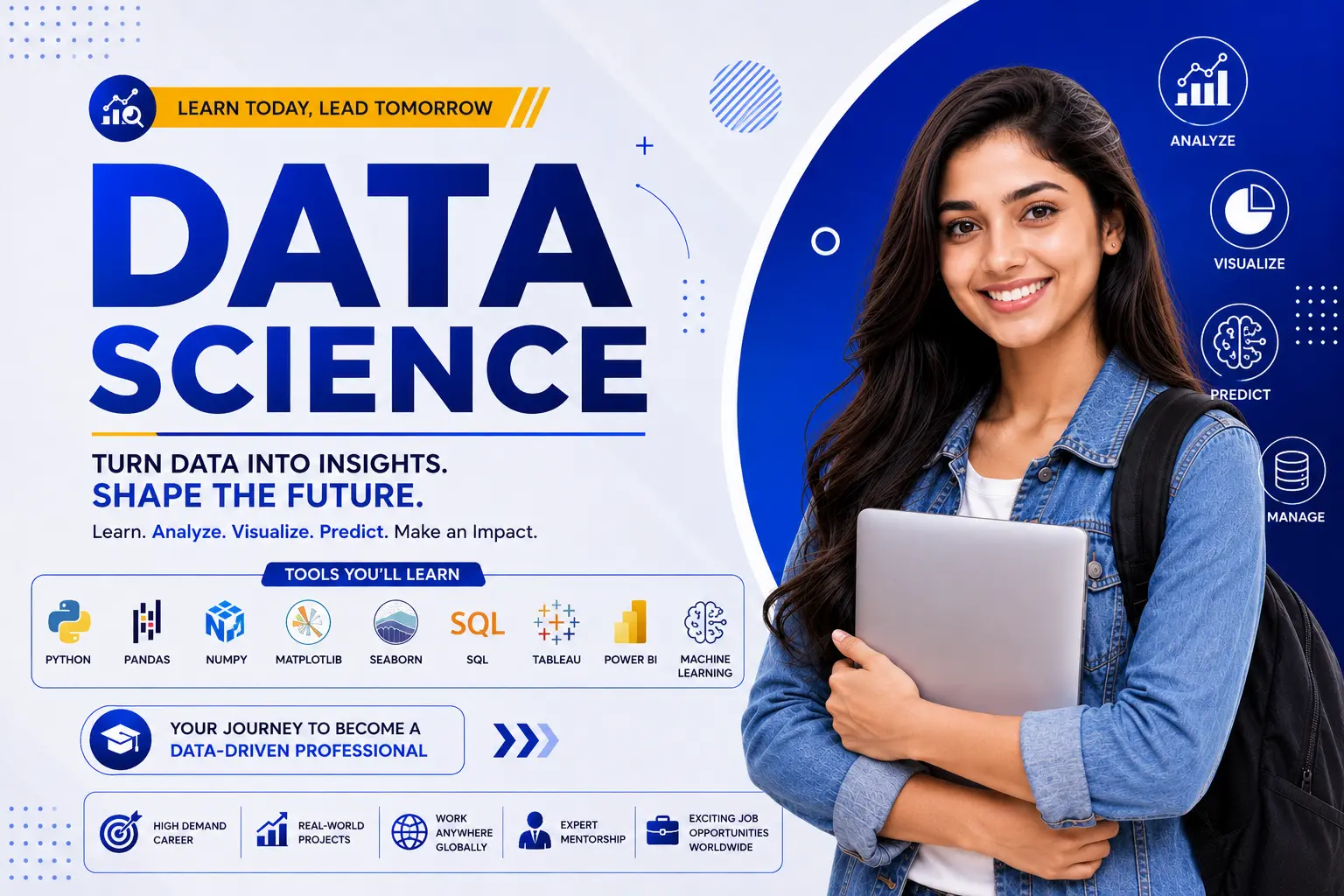 Professional Courses
Data Science Course
Unlock the power of data — the best Data Science program in Sikar for aspiring data professionals.