What is Data Analytics?
Data Analytics is the process of collecting, cleaning, analysing, and understanding data to find useful information and support better business decisions.
A Data Analyst works with different types of business data and uses analytical tools to identify patterns, trends, problems, and opportunities.
A professional Data Analyst course in Sikar can help students build practical skills in Excel, SQL, Python, statistics, data visualisation, and business intelligence tools.
What does a Data Analyst do?
A Data Analyst works with data to help organisations understand what is happening in their business and make data-driven decisions.
Typical responsibilities include collecting data, cleaning datasets, writing SQL queries, analysing information, creating reports, building dashboards, and presenting insights.
Data Analysts may work with sales, marketing, finance, operations, customer, product, or other business data depending on the organisation.
What do you learn in a Data Analyst course?
A good Data Analyst course should start with basic data handling and gradually move towards advanced analytics, visualisation, and business intelligence concepts.
Students can learn Excel for data cleaning, formulas, pivot tables, charts, and basic analysis. SQL can be used to work with databases and retrieve useful information from large datasets.
Python can be introduced for data analysis using libraries such as Pandas and NumPy. Students can also learn basic statistics and exploratory data analysis to understand datasets more effectively.
Data visualisation and business intelligence tools such as Power BI can help students create interactive dashboards, reports, KPIs, and business insights.
The most important part of Data Analytics learning is practical project work. Working with real-world datasets helps students understand how data is analysed in actual business situations.
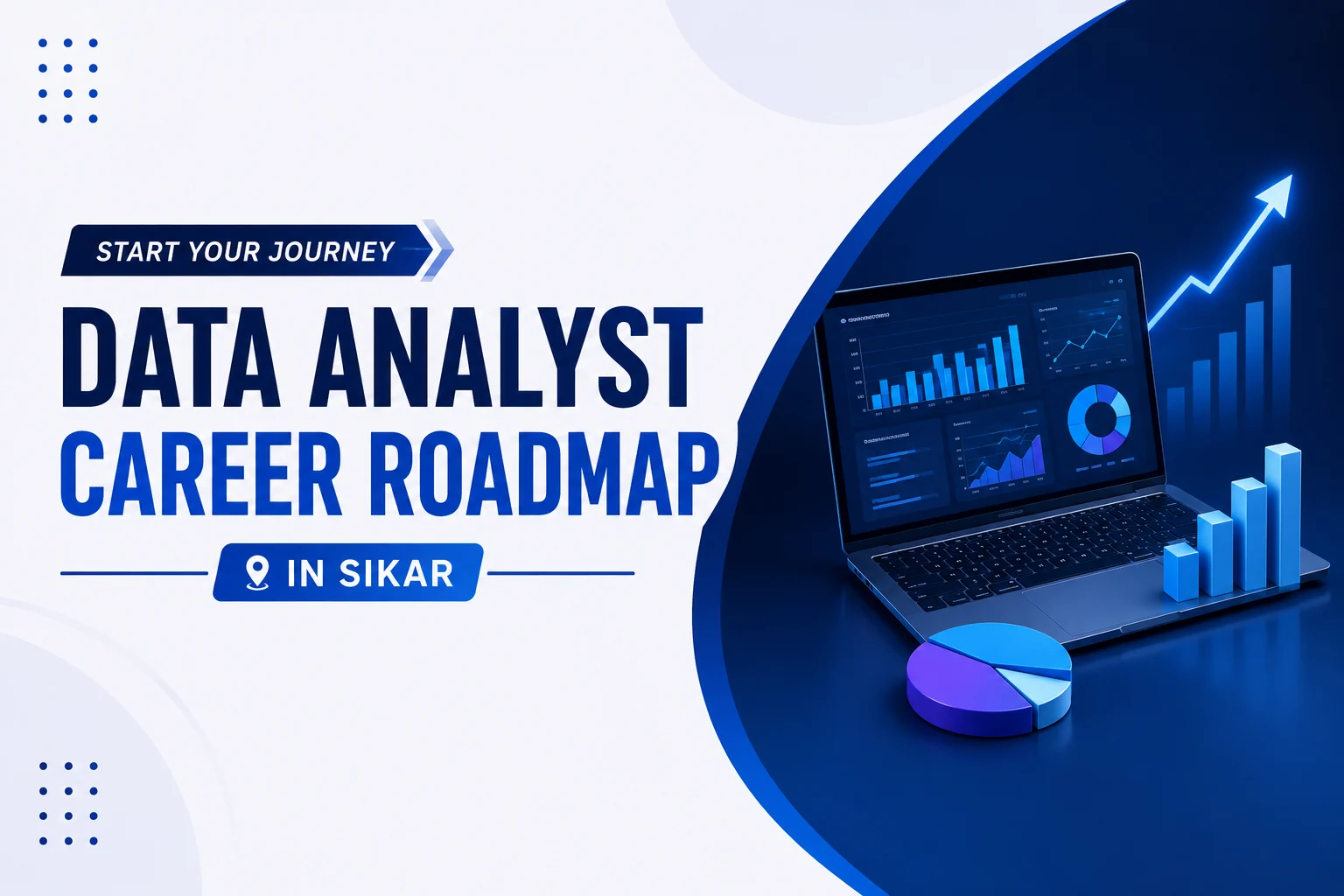
Data Analyst Career Roadmap
Becoming a Data Analyst is a step-by-step process. Students do not need to learn every technology at the same time. Building strong fundamentals first can make advanced analytics easier to understand.
A practical Data Analyst career roadmap can start with Excel, followed by SQL, basic statistics, Python for data analysis, data visualisation, Power BI, real-world projects, portfolio development, and interview preparation.
The roadmap can be understood as: Excel → SQL → Statistics → Python → Pandas & NumPy → Data Visualisation → Power BI → Real-World Projects → Portfolio → Interview Preparation → Job or Internship.
Students should focus on understanding how to solve business problems using data instead of only learning individual tools. A strong portfolio of practical projects can demonstrate analytical and problem-solving skills.
Tools used by Data Analysts
Data Analysts use different tools depending on their role, organisation, and type of data.
Excel is widely used for data cleaning, calculations, analysis, pivot tables, and reporting. SQL is important for querying and working with data stored in relational databases.
Python can be used for data cleaning, analysis, automation, and working with larger datasets. Libraries such as Pandas and NumPy are commonly used for data analysis tasks.
Power BI can be used to create interactive dashboards, reports, KPIs, and visualisations that help businesses understand their data.
Students should focus on learning the purpose and practical use of each tool rather than simply collecting knowledge of many technologies.
Projects every Data Analyst should build
Project work is an important part of becoming job-ready as a Data Analyst. Projects help students apply concepts to real datasets and demonstrate their skills to potential employers.
Students can build projects such as an e-commerce sales analysis dashboard, customer analysis report, marketing campaign analysis, employee analytics dashboard, financial analysis report, or business performance dashboard.
A good project should include data cleaning, analysis, meaningful KPIs, visualisations, insights, and clear business recommendations.
Building multiple projects using different datasets can help students create a practical portfolio that demonstrates their ability to work with data and solve business problems.
Career opportunities after Data Analytics
After developing strong analytical and practical skills, learners can explore entry-level opportunities such as Junior Data Analyst, Data Analyst, Business Analyst, Reporting Analyst, MIS Analyst, or Business Intelligence Analyst.
Data Analytics skills can also be useful for internships, freelance reporting projects, business dashboards, marketing analytics, sales analytics, and other data-driven roles.
Career growth depends on analytical thinking, technical skills, project experience, business understanding, communication skills, and continuous learning rather than completing a course alone.
How to choose a Data Analyst course in Sikar
When comparing Data Analyst courses in Sikar, do not look only at the course name or duration. Check the complete curriculum and the practical skills covered during training.
A practical course should provide hands-on training in Excel, SQL, statistics, Python, data visualisation, Power BI, data cleaning, dashboard creation, and real-world projects.
Students should also check the lab environment, batch size, project work, trainer experience, course structure, portfolio guidance, internship opportunities, and career support before enrolling.
Who can become a Data Analyst?
Data Analytics can be learned by college students, graduates, beginners, and working professionals who want to develop practical data analysis skills.
Students from BCA, MCA, BSc Computer Science, BBA, BCom, engineering, mathematics, statistics, and other backgrounds may find Data Analytics useful. A specific technical degree is not always required to start learning the fundamentals.
Beginners should choose a course that starts with basic data handling and gradually moves towards Excel, SQL, statistics, Python, data visualisation, Power BI, and practical projects.
Next steps
If you are searching for a Data Analyst course in Sikar, compare the curriculum, practical training, tools, projects, trainers, lab facilities, and career support before choosing an institute.
The goal should not be just to complete a Data Analytics course. Focus on developing practical analytical skills and building a portfolio of projects that demonstrates your ability to work with real-world data.
Start with the fundamentals, practise regularly, work on different datasets, build dashboards and analytical projects, and prepare for interviews based on practical problem-solving skills.
Success Point Team
Published By Success Point Team, Sikar.
Frequently asked questions
What is a Data Analyst?
A Data Analyst works with data to identify useful information, trends, patterns, and insights that can help businesses make better decisions.
What is a Data Analyst course?
A Data Analyst course teaches practical skills such as Excel, SQL, statistics, Python, data visualisation, Power BI, data cleaning, reporting, and data analysis.
What is the Data Analyst career roadmap?
A practical roadmap can include Excel, SQL, statistics, Python, Pandas and NumPy, data visualisation, Power BI, real-world projects, portfolio development, and interview preparation.
What tools are used by Data Analysts?
Common tools include Microsoft Excel, SQL, Python, Pandas, NumPy, and Power BI. The exact tools can vary depending on the role and organisation.
Can beginners learn Data Analytics?
Yes. Beginners can learn Data Analytics when the course starts with basic data handling and gradually moves towards Excel, SQL, statistics, Python, visualisation, Power BI, and practical projects.
Can BCA students become Data Analysts?
Yes. BCA students can learn Data Analytics and use it to complement their programming and computer science knowledge with practical data analysis skills.
Can BCom or BBA students learn Data Analytics?
Yes. Students from commerce and management backgrounds can learn Data Analytics, especially when they are interested in business data, reporting, finance, sales, marketing, and decision-making.
Do I need Python to become a Data Analyst?
Python is a useful Data Analytics skill, especially for data cleaning, analysis, automation, and working with larger datasets. However, students should also develop strong Excel, SQL, statistics, and visualisation skills.
Is Power BI important for Data Analysts?
Power BI is a useful business intelligence and data visualisation tool that can help Data Analysts create dashboards, reports, KPIs, and interactive business insights.
What projects should I build while learning Data Analytics?
Students can build projects such as e-commerce sales analysis, customer analysis, marketing analytics, employee analytics, financial analysis, and business performance dashboards.
How do I choose a Data Analyst institute in Sikar?
Compare the curriculum, practical training, tools taught, trainer experience, projects, lab facilities, batch size, internship opportunities, portfolio guidance, and career support before selecting an institute.
Can I get an internship after learning Data Analytics?
Yes. Students with practical analytical skills and a portfolio of projects can apply for Data Analytics internships and entry-level opportunities.
Do I need a degree to become a Data Analyst?
A specific degree is not always required to start learning Data Analytics. Practical skills, analytical thinking, projects, problem-solving ability, and continuous learning are important for building a career.
How long does it take to learn Data Analytics?
The learning time depends on the student's background, practice, course structure, and project work. Becoming job-ready requires consistent practice and practical project experience.
Courses mentioned in this article
 Graduation Courses
BCA (Bachelor of Computer Applications)
A 3‑year honours‑track degree built around real software development — the best BCA in Sikar.
 Post Graduation Courses
MCA (Master of Computer Applications)
A 2‑year postgraduate program for graduates aiming at senior software roles — top MCA in Sikar.